Caliche Pads & Building Pad Construction
Well site pads, building pads, and laydown yards, built out of compacted caliche across Gaines County and the Permian Basin. Level Ground Construction works out of Seminole, Texas.
Tell us what's going on the pad and how big it needs to be. We'll tell you what it takes to build it.
Or send the site details and we'll call you back
Monday to Friday, 7:00 AM to 6:00 PM.
Frank Redekopp, Level Ground Construction
Level Ground Construction is Frank Redekopp's company, run out of Seminole. Around Gaines County the name usually does the introducing on its own. When you call, you're describing your site to the man who is going to stand on it — not to a dispatcher in another state working off a script and a map.
Two very different people read this page. One is running a lease and needs a location built. The other is putting a shop up behind the house and needs something solid under the slab. Both are the same phone call, and the sections below are split so you can go straight to yours.
Septic systems are a separately licensed trade in Texas, and Frank holds the state OSSF licenses for that work. If that's what you're actually here about, it has its own page: septic system installation in Seminole, TX.
What Caliche Is, and Why West Texas Builds on It
Caliche is the pale, chalky rock layer sitting under a great deal of West Texas. It forms in dry country: water carries dissolved calcium carbonate down through the soil, the water evaporates before it gets far, and what it leaves behind cements the soil into a hard layer. Out here that layer often sits within a few feet of the surface, which is why it turns up in nearly every trench and every foundation dig in Gaines County.
That same rock is the most useful building surface in the region. Broken up, spread, and compacted, caliche binds back to itself and sets up firm — hard enough to carry a loaded truck, tight enough to shed water rather than drink it. It comes out of pits around here instead of off a rail car, so the haul is short and the material stays affordable. Concrete and asphalt are better surfaces than caliche. For most of what gets built on a lease or on a farm, they are not better by enough to be worth the difference.
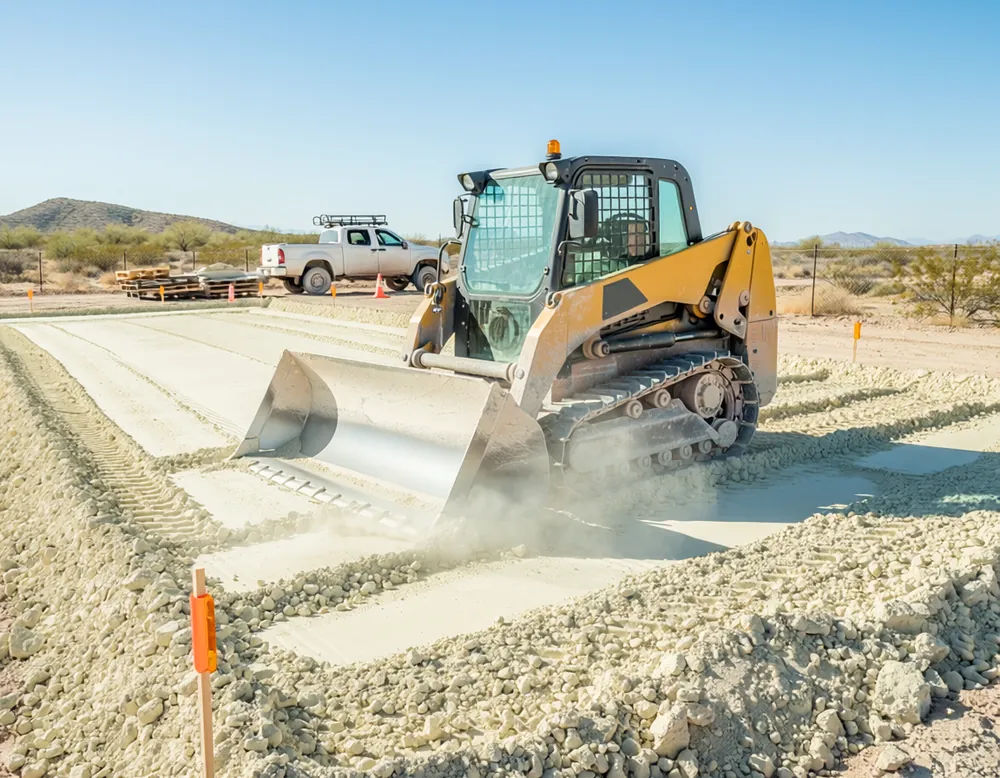
A caliche pad is a compacted caliche surface built to be worked on: a well site, a tank battery, the footprint under a shop, a yard where equipment sits between jobs. The thing worth understanding before you buy one is that a pad is a structure, not a pile of rock. What holds it up is the ground underneath it and the compaction through it — not the material you can see.
Caliche Pads for Well Sites, Tank Batteries & Lease Equipment
This section is for operators, facilities coordinators, and anybody responsible for a lease. A location has to be flat, square to the plan, and stable enough that a rig, a workover unit, or a loaded vacuum truck can sit on it in February and again in July.
The build is the same shape every time, and the details are where it holds or fails. Strip the topsoil and anything organic off the footprint — roots and grass rot, and what rots leaves a hollow. Cut and fill to the elevation the plan calls for. Compact the subgrade before any caliche goes down, because the pad can only be as good as what it sits on. Then build the caliche back up in lifts, compacting each one before the next is spread, instead of dumping the full depth and rolling the top of it.
How deep it needs to be depends on two things: what parks on it, and what the native ground underneath will take. Blow sand that moves needs more base than tight ground that doesn't. Tell us the equipment and the loads and we'll build to those, not to a number picked off a web page.
Building a location around Seminole, Denver City, or Andrews? Call (432) 209-5410.
Building Pads for Homes, Shops & Ag Buildings
This section is for homeowners, ranchers, and builders. A building pad is the raised, compacted platform your slab sits on, and it does two jobs at once. It gives the foundation something firm and even to bear on. And it lifts the finished floor above the ground around it, so that when it rains, the water has somewhere to go besides your building.
Same principle as a lease pad, tighter tolerances. The footprint is cleared and grubbed — roots and stumps out, not just the brush above them. The pad is built out past the building line on every side, because a slab poured to the edge of a pad has nothing holding its corners up. Then it's brought to grade and compacted well enough that a form crew can chalk lines on it and a concrete truck can back across it without leaving ruts.
If you're a builder, give us the slab dimensions, the finished floor elevation you're working to, and the date your form crew needs the pad. Sequence is worth more than anything else on a job like this — a pad that's ready two days late holds up every trade stacked behind it, and everybody remembers that longer than they remember the price.

Got a slab going down this season? Call Frank at (432) 209-5410.
Commercial Laydown Yards Built for Daily Traffic
A laydown yard is the hardest of the three to build well, because it never gets a day off. Pipe and equipment get set down and picked back up. Forklifts turn in the same spot every morning. Trucks come in loaded and leave empty. A yard that was flat in October is rutted by spring if the base was thin or the water had nowhere to run.
So a yard gets laid out around traffic and water before anything else. Where do trucks come in, and where do they turn around? Those areas take the most punishment and want the most base under them. Which way does the site fall, and where does the water go once it gets there? A yard graded dead flat is a yard that holds puddles, and standing water is what turns a caliche surface back into the mud it came from.
We build yards for oilfield and industrial operations — the working surface, the entrance, the turnaround, and the drainage around all of it. If a building, a containment area, or a set of racks is going in later, say so at the start. Grading for it now costs a fraction of cutting it back in once the yard is in use.
Laying out a yard near Seminole, Denver City, or Hobbs? Call (432) 209-5410.
Why Pads Fail, and What Keeps Them From It
Two things wreck a caliche pad, and both of them are decided before the first load is hauled.
Water. Caliche is durable while it stays dry and it comes apart when it doesn't. A pad has to be crowned or sloped so rain runs off the surface and away from the site, and the ground around it has to carry that water off rather than pond against the edge. Get it wrong and the material softens from the outside in: the edges break down, ruts start holding water, and the water in the ruts softens the next layer down.
Compaction. Caliche placed in one thick lift compacts on top and stays loose underneath. It looks finished the day it's built and it starts pumping and rutting the first time it's loaded. Building in lifts and compacting each one takes longer and costs more up front, and it is the whole difference between a pad that lasts and a pad that gets built twice.
There's a third, and it's the one nobody sees: what got left underneath. Topsoil, roots, buried trash, and old uncompacted fill all settle at different rates and at different times. Anything organic under a pad rots and leaves a void behind it. Stripping is not the line item to economize on.
Re-Topping: Pads Wear, and That's Normal
A caliche pad is not a permanent surface and nobody should sell you one as if it were. Traffic grinds the top layer to dust, wind carries the dust off, and rain moves what's left downhill. A working pad loses material every year it's used. That isn't a defect — it's what the surface does.
The repair is a re-top: fresh caliche spread over the existing surface, bladed back to grade, and compacted. It costs a fraction of building new, because the base underneath is still doing its job. The time to do it is while the surface still sheds water. Once the ruts are deep enough to hold puddles, the damage has started going down into the base, and the repair stops being a re-top.
If you've got a pad or a yard getting rough, call and describe what it's doing rather than what it looks like. Ruts, soft spots that only show up after rain, and washboard with a lot of dust are three different problems, and they don't get the same fix.
Pad getting rough? Call (432) 209-5410 and describe what it's doing.
Driving Surfaces Are a Different Job
Caliche does two different jobs and they aren't built the same way. This page is about surfaces you build on — pads, slab bases, and yards, where the load mostly sits still and spreads out over an area. A driving surface is a different problem. It's long and narrow, it takes the same wheels in the same two tracks every single day, and it has to shed water sideways off a crown for its whole length or it turns into a ditch.
If a drive or a lease road is what you're after, it's covered here: caliche and gravel driveway installation. If the ground has to be cleared, cut, or leveled before any of this can start, that's dirt work, excavation and grading. And everywhere Level Ground works is on the service areas page.
Talk to Frank About Your Pad
Tell us the town, what's going on the pad, roughly how big it needs to be, and when you need it. That's enough to have a real conversation about. If the site has to be cleared or leveled first, that's the same company and the same trip — it doesn't need a second contractor and a second schedule.
Can't talk right now? Send the site details instead
Monday to Friday, 7:00 AM to 6:00 PM · sales@lgctexas.com
We build pads, building pads and laydown yards in Seminole, Seagraves, Loop, Denver City, Andrews, Brownfield, Lamesa, Midland and Odessa, Texas, and in Hobbs and Lovington, New Mexico. See everywhere we work →