
Dirt Work, Excavation & Grading in Gaines County, TX
Clearing, leveling, hauling, trenching, and grading for farms, ranches, homesites, and commercial jobs — from Seminole out across the Permian Basin.
Say where the property is and what the ground is doing. That's usually enough to know what the job is.
Or send the details and we'll call you back
Monday to Friday, 7:00 AM to 6:00 PM.
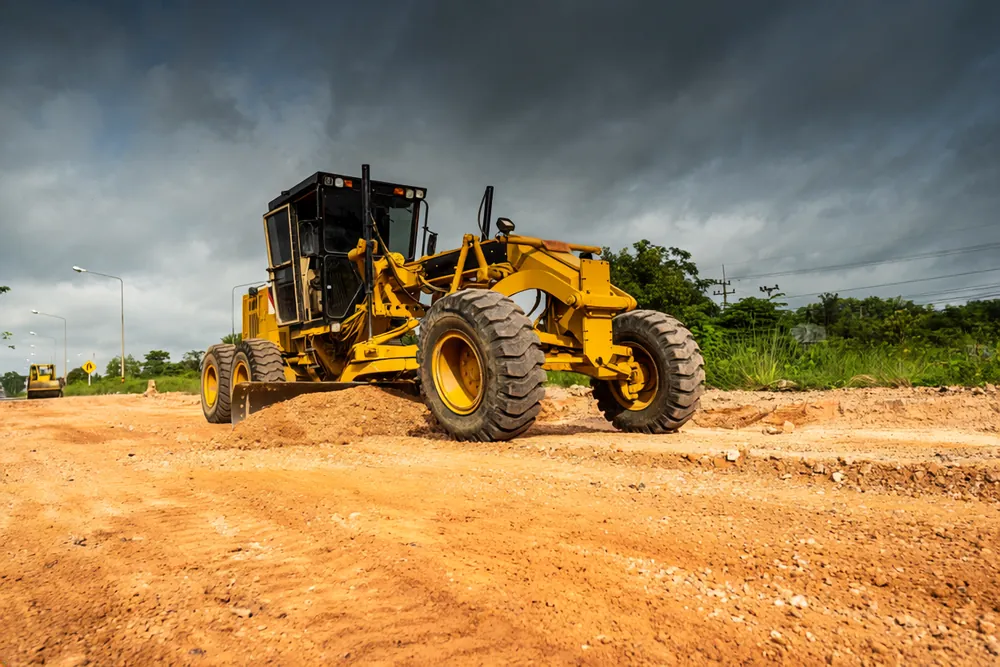
Dirt Work, Excavation, Grading — Three Different Jobs
People use these three words for one another, and on a job site they mean different things. Dirt work is moving material: clearing what's standing on the ground, and hauling dirt onto or off the property. Excavation is digging into it, to a depth and along a line. Grading is shaping the surface so that water goes where you want it to go. Most jobs need two of the three, and the order they happen in is what stops the last one from undoing the first.
Dirt Work: Clearing, Leveling, Hauling & Fill
Clearing comes first. Mesquite, brush, a fence line that's disappeared, an old set of pens, a slab nobody has used since the eighties. Clearing done properly is grubbing as well as cutting — the roots come out too. Mesquite in particular will find its way back up through whatever you build on top of it if the root is still down there.
Then leveling: knocking the high ground down, filling the low ground in, and getting a site to sit the way it needs to sit. On country this flat the differences look like nothing from the window of a truck. They stop looking like nothing the first time water runs across them.
Hauling and fill placement is the third piece. Some properties have material to spare and some need it brought in, and either way, moving dirt is what costs money. A job that balances what's cut against what's filled on the same property is cheaper than one that hauls twice. That's a question worth asking before the work starts rather than after.
The usual calls: clearing a homesite on raw land, opening up a fence line, taking out an old drive or slab, filling a low spot that holds water every spring, and bringing material in for a build.
Land that needs clearing? Call Frank at (432) 209-5410.
Excavation: Site Cuts, Trenching, Depth & Alignment
Excavation is the digging half. Site cuts, where a site comes down to a working elevation before anything is built on it. Trenching, for water lines, electrical, gas, drain lines, and footings. And bulk removal, where a large volume of material simply has to come out and go somewhere.
Trenching is where precision earns its keep. A line has to sit at the right depth, on the right alignment, in ground somebody checked first. Around here, checking first means caliche — and caliche is slow to dig. A trench that would be an afternoon's work in sand takes considerably longer through rock. That isn't a surprise so much as a condition, and it belongs in the conversation at the start instead of turning up at noon on the first day.
Anything buried gets located before a machine goes in the ground. That's one call to 811 ahead of the dig, and it costs nothing. Putting a bucket through a gas line or a fiber trunk is the most expensive mistake available on a dirt job, and it's the easiest one to avoid.
When you call, say what's going in the ground and how deep it has to be. Depth drives the machine, the spoil, and how the trench gets backfilled — a line running under a future driveway gets put back differently than one running under pasture.
Need a trench run? Call (432) 209-5410 with the depth and the length.
Grading: Deciding Where Your Water Goes for the Next Twenty Years
Grading is the least understood thing on this page, and it's the one that decides whether a building has a quiet life or an expensive one. The whole idea fits in a sentence: water runs downhill, and grading is choosing which downhill.
Rain that lands on a roof, a pad, or a drive has to end up somewhere. If the ground falls away from the building on every side, the water leaves and nothing much happens. If the ground falls toward the building — or worse, sits dead flat — the water stands against the slab instead. It doesn't announce itself at the time. It shows up years later as a foundation that has moved, a shop floor that sweats, a crack running up one corner of the house, or a septic drainfield that quit working because the ground above it never gets a chance to dry out.
It's easy to get wrong out here, because West Texas looks flat and isn't. A fall of a few inches across a hundred feet is invisible to somebody standing on it and decides everything about where the water ends up. That's why grade gets shot with an instrument rather than judged by eye, and why "it looks level" is not the same statement as "it drains."
Rough grading and finish grading are two different passes. Rough grading brings the site to the shape and the elevations the plan calls for — that's the bulk of the material moving. Finish grading is the last inch or two: smoothing the surface, tying the new work into the ground around it, and setting the exact fall away from the building. Rough grade decides whether the job works. Finish grade decides whether it looks like somebody knew what they were doing.
Grading also fixes problems that already exist, and that's a good half of these calls. Water standing in the same spot after every rain. A drive that turns to soup and stays that way for three days. A yard that drains into the shop instead of away from it. A pad that has settled and now holds a pond in one corner. Those are grade problems, and most of them get corrected without touching the building at all.
Water going the wrong way? Call Frank at (432) 209-5410 and describe where it stands.
What Order a Dirt Job Runs In
Most jobs follow the same sequence. It's worth knowing, because the money on a dirt job is usually lost by doing something twice.
- Walk the site. What's standing on it, which way it falls, where the water goes now, and what's buried.
- Clear and grub. Brush, stumps, roots, old structures — anything organic comes off the footprint and out of it.
- Strip the topsoil. It gets stockpiled, not thrown away. It's the material you want back on the yard at the end, and the material you never want left under a pad.
- Cut and fill. High ground down, low ground up, balanced on the property wherever the site allows it.
- Trench. Utilities, drain lines, and septic lines go in before the surface is finished, not after it.
- Rough grade. The site takes its shape and its elevations.
- Build what's going on it. Pad, slab, drive, or building.
- Finish grade. Final fall away from the structure, tie-ins to the surrounding ground, and cleanup of everything the machines disturbed.
Where a job goes sideways is nearly always the order. A trench cut after the grading is finished means grading again. A pad built before the drainage was worked out sometimes means moving the pad. Tell us what the finished site has to do, and the sequence mostly sorts itself out.
Two Kinds of People Call About Dirt Work
- Homeowners, ranchers, and farmers. Clearing a homesite, opening a fence line, fixing the spot that floods, leveling a set of pens, getting ground ready for a shop or a barn. Usually one property, usually a few days, and usually a problem you can point at from the porch.
- Builders, GCs, and operators. Site cuts, utility trenching, and rough and finish grade, on a schedule with other trades stacked behind it. The question here is rarely whether the work can be done — it's whether it can be done the week you need it. Call with the dates and you'll get a straight answer about whether we can hold them.
Frank Redekopp Looks at the Job Himself
Level Ground Construction is Frank Redekopp's business, out of Seminole, and in Gaines County that name handles most of the introduction. Dirt work is a trade where the estimate and the work are the same man's problem: whoever tells you what your ground needs is the one who then has to go and be right about it.
That's the argument for hiring somebody local over dialing a number off a page that lists forty towns. He has dug in this dirt. He knows how far down the caliche usually is, what blow sand does under a load, and which way the water runs when it finally does rain.
Septic systems are licensed separately in Texas, and Frank holds the state OSSF licenses for that work. If your dirt job is really a septic job, start here instead: septic system installation in Seminole, TX.
Talk to Frank About Your Ground
Tell us where the property is, what the ground is doing now, and what you need it to do instead. Brush that has to come off, a trench that has to go in, a site that has to come level, water standing where it shouldn't — all of it starts with the same phone call.
Can't talk right now? Send the details instead
Monday to Friday, 7:00 AM to 6:00 PM · sales@lgctexas.com
We do dirt work, excavation and grading in Seminole, Seagraves, Loop, Denver City, Andrews, Brownfield, Lamesa, Midland and Odessa, Texas, and in Hobbs and Lovington, New Mexico. See everywhere we work →